Showing posts with label Saints on Saturdays. Show all posts
Monday, December 3, 2012
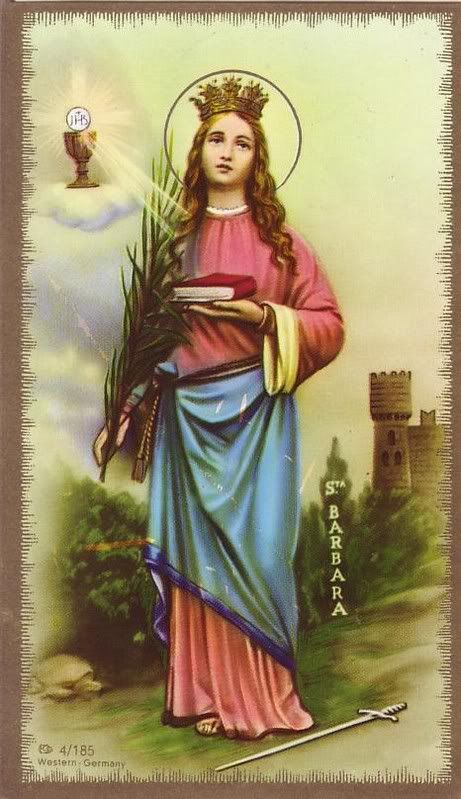
St Barbara, Ora pro nobis!
Sorry about the formatting being so wonky, but here is a beautiful meditation from Dom Guerrangère's The Liturgical Year for today's feast of St Barbara. Happy advent to all! Don't forget to plant your wheat for the crèche today!
SAINT BARBARA, VIRGIN AND MARTYR
ALTHOUGH, in the Roman liturgy, St. Barbara is merely commemorated in the Office of St. Peter Chrysologus, yet the Church has approved an entire Office for the use of those Churches which honour
the memory of this illustrious virgin in a special manner. The legend which follows, although of considerable weight, has not, consequently, the authority of those which are promulgated for the use of the whole Church, in the Roman breviary. Let us not, on this account, be less fervent in honouring this glorious martyr, so celebrated in the east, and whose feast has been for so many ages admitted, with more or less solemnity, into the Roman Church. The acts of her martyrdom, though not of the highest antiquity, contain nothing in them but what redounds to the glory of God and the honour of the saint. We have already shown the liturgical importance which attaches to St. Barbara in this season of Advent. Let us admire the constancy wherewith this virgin waited for her Lord, who came at the appointed hour, and was for her, as the Scripture speaks, a Spouse of blood, because He put the strength of her love of Him to the severest of all tests.
Barbara, a virgin of Nieo·
media, the daughter of Dios·
coru~, a nobleman but a
superstitious pagan, came
readily, by the assistance of
divine grace, from the con·
templation of the visible
things of creation to the
knowledge of the invisible.
Wherefore, she devoted her·
self to God alone and to the
things of God. Her father,
desirous to preserve her from
all danger of insult, to which
he feared her great beauty
might expose her, shut her
up in a tower. There the
pious virgin passed her days
in meditation and prayer,
studying to please God
alone, whom she had chosen
as her Spouse. She cour·
ageously rejected several
offers of marriage, which
were made to her, through
her father, by rich nobles.
But her father hoped that,
by separating himself by a
long absence from his child,
her intentions would easily
change. Ile first ordered
that a bath should be built
for her in the tower, 80 that
she might want for nothing;
and then he set out on a
journey into distant coun·
tries.
During her father's abo
sence, 'Barbara ordered that
to the two windows already
in the tower a third should
be added, in honour of the
blessed Trinity; and that
on the edge of the bath the
sign of the most holy cross
should be drawn. When
Dioscorus returned home,
and saw these changes, and
was told their meaning, he
became so incensed against
his daughter, that he wont in
search of her with a naked
sword in his hand, and, but
for the protection of God,
he would have cruelly murdered
her. Barbara had
taken to Hight: an immense
rock opened before her, and
she found a path by which
she reached the top of a
mountain, and there she hid
herself in a cave. Not long
after, however, she was discovered
by her unnatural
father, who savagely kicked
and struck her, and dragging
her by the hair over the
sharp rocks, and rugged
ways, he handed her over to
the governor Marcian, that
he might punish her. He,
therefore, having used evcry
means to shake her constancy,
and finding that all
was in vain, gave ordcrs
for her to be stripped and
scourged with thongs, to
have her wounds scraped with
potsherds, and then to bo
dragged to prison. There
Christ, surrounded by an
immense light, appearing to
her, strengthened her in a
divine manner for the sufferings
she was yet to endure.
A matron, named Juliana.,
who witnessed this, was converted
to the faith, and
became her companion in
martyrdom.
At length Barbara had her
body torn with iron hooks,
her sides burnt with torches,
and her head bruised with
mallets. During these tor·
tures she consoled her com·
panion, and exhorted her to
fight manfully to the last.
Both of them had their
breasts cut off, were dragged
naked through the streets,
and beheaded. Tho head of
Barbara was out off by her
own father, who in his exces·
sive wickedness had hardened
his heart thus far. But his
ferocious cruelty was not
long left unpunished, for
instantly, and on the very
spot, he was struck dead by
lightning. The emperor
Justinus had the body of
this most holy virgin trans·
lated from Nioomedia to
Constantinople. It was after·
wards obtained by the Vene·
tians from the emperors
Constantine and Basil; and
having been translated from
Constantinople to Venice,
was deposited with great so·
lemnity in the basilica of St.
Mark. Lastly, at the earnest
request of the bishop of
Toreello and his sister, who
was abbess, it was translated
in the year of grace 1009, to
the nuns' church of St.
John the Evangelist, in the
diocese of Toreello ; where it
was placed in 0. worthy se·
pulchre. and from that time
has never ceased to be the
object of most fervent vene·
ration.
Such is the account of the life and martyrdom of
the courageous virgin of Nicomedia. She is invoked
in the Church against lightning, on account of the
punishment inflicted by divine justice on her execrable
father. This same incident of the saint's history has
suggested several Catholic cuswms: thus her name
is sometimes given w the hold of men-of war where
the ammunition is stowed; she is the patroness of
artillery men, miners, etc. ; and she is invoked by the
faithful against the danger of a sudden death.
Of the liturgical pieces, used in our western Churches
in honour of St. Barbara, we will content ourselves
with the following beautiful antiphon, composed in
the days of chivalry.
ANTIPHON
o divinre bonitatis immensa
clementia, qure Barbaram
illustravit vero claritatis
lumine, ut tcrrenre
dignitatis contempto splendore,
divinitatis conscia effici
mereretur: hrec vdut
lilium inter spinis enituit,
et lux in tenebris eluxit.
Alleluia.
o immeasurable mercy of
divine goodness, which did
enlighten Barbara with the
brightness of the true light,
making her worthy, by her
contempt for what was daz·
zling in earthly grandeur, to
be admitted to a. union with
God! As the lily among
thorns, as light in darkness,
80 shone Barbara. Alleluia.
The Greek Church is profuse in its praises of St.
Barbara. We will take from the Memea a few out of
the many strophes which are sung in honour of the
holy martyr:
HYMN OF THE GREEK CHURCH
When welcome death carne
before thee, 0 venerable martyr
Barbara! joyously and
nimbly didst thou run thy
course, and being immolated
by the wicked hands of an
impious parent, thou wast
offered a victim to God.
Now, therefore, art thou in
the choir of the truly wise
virgins, and contemplatest
the beauty of thy Spouse.
This lamb of thine, 0
Jesus, cries to thee with a.
loud voice: Thee, 0 my
Spouse, do I desire, thee do
I seek by my combat; I am
immolated and buried in thy
baptism; I suffer for thee,
that I ma.y reign with thee;
I die for thee, that I may live
in thee; receive me, therefore,
as a.n unreserved sacrifice
lovingly sacrificed to
thee. Save our souls, 0 merciful
Jesus, by her prayers.
Glorious Barbara I most
sacred rose grown out of a
thorny stem, sweetly perfuming
the Church, and ruddy
by the blood of thy battle!
we this day most fervently
proclaim thee blessed.
Neither the sweetness of
luxury, nor the flower of
beauty, nor riches, nor the
pleasures of youth, could rob
thee of thy energy, 0 glorious
Barbara, most fair virgin,
espoused to Christ.
All stood in amazement at
witnessing thy combat; for
thou didst endure the tortures,
and chains, and cruelties,
of thy persecutors, 0
Barbara, of wide-world fame!
Therefore, did God give thee
the crown thou didst covet;
thou didst run thy course
with courage, and he healed
thee.
Full of love for Jesus thy
Spouse, thy bright lamp was
well trimmed, and thy virtucs
shed forth their splendour,
0 virgin worthy of
praise!
Sunday, October 7, 2012
One of the ways we start our day is with morning prayer. Most days, we read Liturgy of the Hours official morning prayer. But on some days we are rushed or just need a break from the complexity of the official liturgy of the Church... after all, my kids are very young and I never want to burden them with prayer. On those days we read the Lorica, or breastplate of St Patrick, the patron saint of Ireland, a Bishop who was born around 340.
It is so good that I sometimes use it instead of the invitatory psalm. I also use it in warfare. It pumps us up for the battle ahead and keeps us focused, and like most Celtic prayers it makes faith the substance of a real and tangible world.
We are proud of the Irish heritage in this house and continue to be amazed at all that Ireland has represented to the world through its history and faith.
I hope this simple prayer blesses you as much as it has blessed us!
ST PATRICK’S BREASTPLATE
I bind unto myself today
The strong Name of the Trinity,
By invocation of the same
The Three in One and One in Three.
I bind this today to me forever
By power of faith, Christ’s incarnation;
His baptism in Jordan river,
His death on Cross for my salvation;
His bursting from the spicèd tomb,
His riding up the heavenly way,
His coming at the day of doom
I bind unto myself today.
I bind unto myself the power
Of the great love of cherubim;
The sweet ‘Well done’ in judgment hour,
The service of the seraphim,
Confessors’ faith, Apostles’ word,
The Patriarchs’ prayers, the prophets’ scrolls,
All good deeds done unto the Lord
And purity of virgin souls.
I bind unto myself today
The virtues of the star lit heaven,
The glorious sun’s life giving ray,
The whiteness of the moon at even,
The flashing of the lightning free,
The whirling wind’s tempestuous shocks,
The stable earth, the deep salt sea
Around the old eternal rocks.
I bind unto myself today
The power of God to hold and lead,
His eye to watch, His might to stay,
His ear to hearken to my need.
The wisdom of my God to teach,
His hand to guide, His shield to ward;
The word of God to give me speech,
His heavenly host to be my guard.
Against the demon snares of sin,
The vice that gives temptation force,
The natural lusts that war within,
The hostile men that mar my course;
Or few or many, far or nigh,
In every place and in all hours,
Against their fierce hostility
I bind to me these holy powers.
Against all Satan’s spells and wiles,
Against false words of heresy,
Against the knowledge that defiles,
Against the heart’s idolatry,
Against the wizard’s evil craft,
Against the death wound and the burning,
The choking wave, the poisoned shaft,
Protect me, Christ, till Thy returning.
Christ be with me, Christ within me,
Christ behind me, Christ before me,
Christ beside me, Christ to win me,
Christ to comfort and restore me.
Christ beneath me, Christ above me,
Christ in quiet, Christ in danger,
Christ in hearts of all that love me,
Christ in mouth of friend and stranger.
I bind unto myself the Name,
The strong Name of the Trinity,
By invocation of the same,
The Three in One and One in Three.
By Whom all nature hath creation,
Eternal Father, Spirit, Word:
Praise to the Lord of my salvation,
Salvation is of Christ the Lord.
All the Saints of Ireland
R/ Ora pro nobis!
SERVIAM!
Saturday, October 29, 2011
Saints on Saturdays- The universality of Catholicity
To be 'Catholic' means to love your country and to be second to no one in that love. And at the same time, to hold as your own the noble aspirations of other lands. — So many glories of France are glories of mine! And in the same way, much that makes Germans proud, and the peoples of Italy and of England..., and Americans and Asians and Africans, is a source of pride to me also.
Catholic: big heart, broad mind.
--St Josemaria Escriva, The Way, 525
Friday, October 7, 2011
Happy feast of Our Lady of the Rosary!!
Why not take today to start making a habit out of praying the rosary?
From the Catechism of the Catholic Church:
971 "All generations will call me blessed": "The Church's devotion to the Blessed Virgin is intrinsic to Christian worship." The Church rightly honors "The Blessed Virgin with special devotion. From the most ancient times the Blessed Virgin has been honored with the title of 'Mother of God', to whose protection the faithful fly in all their dangers and needs...This special devotion...differs essentially from the adoration which is given to the incarnate Word and equally to the Father and the Holy Spirit, and greatly fosters this adoration." The liturgical feasts dedicated to the Mother of God and Marian prayer, such as the rosary, an "epitome of the whole Gospel," express this devotion to the Virgin Mary.
1674 Besides sacramental liturgy and sacramentals, catechesis must take into account the forms of piety and popular devotions among the faithful. The religious sense of the Christian people has always found expression in various forms of piety surrounding the Church's sacramental life, such as the veneration of relics, visits to sanctuaries, pilgrimages, processions, the stations of the cross, religious dances, the rosary, medals, etc.
2678 Medieval piety in the West developed the prayer of the rosary as a popular substitute for the Liturgy of the Hours. In the East, the litany called the Akathistos and the Paraclesis remained closer to the choral office in the Byzantine churches, while the Armenian, Coptic, and Syriac traditions preferred popular hymns of St. Ephrem or St Gregory of Narek, the tradition of prayer is basically the same.
2708 Meditation engages thought, imagination, emotion, and desire. This mobilization of faculties is necessary in order to deepen our convictions of faith, prompt the conversion of our heart, and strengthen our will to follow Christ. Christian prayer tries above all to mediate on the mysteries of Christ, as in lectio divina or the rosary. This form of prayerful reflection is of great value, but Christian prayer should go further: to the knowledge of the love of the Lord Jesus, to union with him.
RECITATION OF THE HOLY ROSARY
MEDITATION OF HIS HOLINESS BENEDICT XVI
Pontifical Shrine of Pompeii
Sunday, October 19, 2008
Venerable Brothers in the Episcopate and in the Priesthood,
Dear men and women religious,
Dear Brothers and Sisters,
Before entering the Shrine to recite the Holy Rosary with you, I paused briefly before the tomb of Bl. Bartolo Longo and, praying, I asked myself: "Where did this great apostle of Mary find the energy and perseverance he needed to bring such an impressive work, now known across the world, to completion? Was it not in the Rosary, which he accepted as a true gift from Our Lady's Heart?" Yes, that truly was how it happened! The experience of the Saints bears witness to it: this popular Marian prayer is a precious spiritual means to grow in intimacy with Jesus, and to learn at the school of the Blessed Virgin always to fulfil the divine will. It is contemplation of the mysteries of Christ in spiritual union with Mary as the Servant of God Paul VI stressed in his Apostolic Exhortation Marialis cultus (n. 46) and as my venerable Predecessor John Paul II abundantly illustrated in his Apostolic Letter Rosarium Virginis Mariae that today I once again present in spirit to the Community of Pompeii and to each one of you. You who live and work here in Pompeii, especially you, dear priests, men and women religious and lay people involved in this unique portion of the Church, are all called to make Bl. Bartolo Longo's charism your own and to become, to the extent and in the way that God grants to each one, authentic apostles of the Rosary.
To be apostles of the Rosary, however, it is necessary to experience personally the beauty and depth of this prayer which is simple and accessible to everyone. It is first of all necessary to let the Blessed Virgin take one by the hand to contemplate the Face of Christ: a joyful, luminous, sorrowful and glorious Face. Those who, like Mary and with her, cherish and ponder the mysteries of Jesus assiduously, increasingly assimilate his sentiments and are conformed to him. In this regard, I would like to quote a beautiful thought of Bl. Bartolo Longo: "Just as two friends, frequently in each other's company, tend to develop similar habits", he wrote, "so too, by holding familiar converse with Jesus and the Blessed Virgin, by meditating on the mysteries of the Rosary and by living the same life in Holy Communion, we can become, to the extent of our lowliness, similar to them and can learn from these supreme models a life of humility, poverty, hiddenness, patience and perfection" (I Quindici Sabati del Santissimo Rosario, 27th edition, Pompeii, 1916, p. 27: cited in Rosarium Virginis Mariae, n. 15).
The Rosary is a school of contemplation and silence. At first glance, it could seem a prayer that accumulates words, therefore difficult to reconcile with the silence that is rightly recommended for meditation and contemplation. In fact, this cadent repetition of the Hail Mary does not disturb inner silence but indeed both demands and nourishes it. Similarly to what happens for the Psalms when one prays the Liturgy of the Hours, the silence surfaces through the words and sentences, not as emptiness, but rather as the presence of an ultimate meaning that transcends the words themselves and through them speaks to the heart. Thus, in reciting the Hail Mary, we must be careful that our voices do not "cover" the voice of God who always speaks through the silence like the "still small voice" of a gentle breeze (1 Kgs 19: 12). Then how important it is to foster this silence full of God, both in one's personal recitation and in its recitation with the community! Even when the Rosary is prayed, as today, by great assemblies, and as you do in this Shrine every day, it must be perceived as a contemplative prayer. And this cannot happen without an atmosphere of inner silence.
I would like to add a further reflection concerning the Word of God in the Rosary, particularly appropriate in this period in which the Synod of Bishops is taking place on the theme: "The Word of God in the life and mission of the Church". If Christian contemplation cannot leave the Word of God out of consideration, if it is to be a contemplative prayer, the Rosary must always emerge from the silence of the heart as a response to the Word, after the model of Mary's prayer. Seen clearly, the Rosary is completely interwoven with scriptural elements. First of all there is the enunciation of the mystery, preferably made, as it has been today, with words taken from the Bible. The Our Father follows; by giving the prayer a "vertical" orientation, the soul of who recites the rosary is opened to the correct filial attitude in accordance with the Lord's invitation: "When you pray say: Father..." (Lk 11: 2). The first part of the Hail Mary, also taken from the Gospel, lets us listen again each time to the words that God addressed to the Virgin through the Angel and to the words of her cousin Elizabeth's blessing. The second part of the Hail Mary resounds like the answer of children who, in addressing supplications to their Mother, do nothing other than express their own adherence to the saving plan revealed by God. Thus the thought of those who pray remains ever anchored to Scripture and to the mysteries presented in it.
Lastly, remembering that today we are celebrating World Mission Sunday, I wish to recall the apostolic dimension of the Rosary, a dimension that Blessed Bartolo Longo lived intensely, drawing inspiration from it to carry out on this earth so many charitable initiatives and works of human and social promotion. Furthermore, he wanted this Shrine to be open to the whole world as a centre of outreach of the prayer of the Rosary and as a place of intercession for peace among peoples. Dear friends, I would like to reinforce both of these aims: the apostolate of charity and prayer for peace, and I wish to confirm and entrust them once again to your spiritual and pastoral commitment. Following the example and with the support of the venerable Founder, never tire of working with enthusiasm in this part of the Lord's vineyard for which Our Lady has shown a special fondness.
Dear brothers and sisters, the time has come to take my leave of you and of this beautiful Shrine. I thank you for your warm welcome and especially for your prayers. I thank the Archbishop Prelate and Pontifical Delegate, his collaborators and those who worked to prepare my Visit in the best possible way. I must leave you, but my heart remains close to this region and to this community. I entrust you all to the Blessed Virgin of the Holy Rosary and I cordially impart the Apostolic Blessing to each one.
© Copyright 2008 - Libreria Editrice Vaticana
Saturday, October 1, 2011
Saints on Saturdays-St Jerome
SAINT JEROME CONFESSOR, DOCTOR OF THE CHURCH—342-420
Feast: September 30
St. Jerome, who was born Eusebius Hieronymous Sophronius, was the most learned of the Fathers of the Western Church. He was born about the year 342 at Stridonius, a small town at the head of the Adriatic, near the episcopal city of Aquileia. His father, a Christian, took care that his son was well instructed at home, then sent him to Rome, where the young man's teachers were the famous pagan grammarian Donatus and Victorinus, a Christian rhetorician. Jerome's native tongue was the Illyrian dialect, but at Rome he became fluent in Latin and Greek, and read the literatures of those languages with great pleasure. His aptitude for oratory was such that he may have considered law as a career. He acquired many worldly ideas, made little effort to check his pleasure-loving instincts, and lost much of the piety that had been instilled in him at home. Yet in spite of the pagan and hedonistic influences around him, Jerome was baptized by Pope Liberius in 360. He tells us that "it was my custom on Sundays to visit, with friends of my own age and tastes, the tombs of the martyrs and Apostles, going down into those subterranean galleries whose walls on both sides preserve the relics of the dead." Here he enjoyed deciphering the inscriptions.
After three years at Rome, Jerome's intellectual curiosity led him to explore other parts of the world. He visited his home and then, accompanied by his boyhood friend Bonosus, went to Aquileia, where he made friends among the monks of the monastery there, notably Rufinus. Then, still accompanied by Bonosus, he traveled to Treves, in Gaul. He now renounced all secular pursuits to dedicate himself wholeheartedly to God. Eager to build up a religious library, the young scholar copied out St. Hilary's books on and his Commentaries on the Psalms, and got together other literary and religious treasures. He returned to Stridonius, and later settled in Aquileia. The bishop had cleared the church there of the plague of Arianism and had drawn to it many eminent men. Among those with whom Jerome formed friendships were Chromatius (later canonized), to whom Jerome dedicated several of his works, Heliodorus (also to become a saint), and his nephew Nepotian. The famous theologian Rufinus, at first his close friend, afterward became his bitter opponent. By nature an irascible man with a sharp tongue, Jerome made enemies as well as friends. He spent some years in scholarly studies in Aquileia, then, in search of more perfect solitude, he turned towards the East. With his friends, Innocent, Heliodorus, and Hylas, a freed slave, he started overland for Syria. On the way they visited Athens, Bithynia, Galatia, Pontus, Cappadocia, and Cilicia.
The party arrived at Antioch about the year 373. There Jerome at first attended the lectures of the famous Apollinaris, bishop of Laodicea, who had not yet put forward his heresy1 With his companions he left the city for the desert of Chalcis, about fifty miles southeast of Antioch. Innocent and Hylas soon died there, and Heliodorus left to return to the West, but Jerome stayed for four years, which were passed in study and in the practice of austerity. He had many attacks of illness but suffered still more from temptation. "In the remotest part of a wild and stony desert," he wrote years afterwards to his friend Eustochium, "burnt up with the heat of the sun, so scorching that it frightens even the monks who live there, I seemed to myself to be in the midst of the delights and crowds of Rome.... In this exile and prison to which through fear of Hell I had voluntarily condemned myself, with no other company but scorpions and wild beasts, I many times imagined myself watching the dancing of Roman maidens as if I had been in the midst of them. My face was pallid with fasting, yet my will felt the assaults of desire. In my cold body and my parched flesh, which seemed dead before its death, passion was still able to live. Alone with the enemy, I threw myself in spirit at the feet of Jesus, watering them with my tears, and tamed my flesh by fasting whole weeks. I am not ashamed to disclose my temptations, though I grieve that I am not now what I then was."
Jerome added to these trials the study of Hebrew, a discipline which he hoped would help him in winning a victory over himself. "When my soul was on fire with wicked thoughts," he wrote in 411, "as a last resort, I became a pupil to a monk who had been a Jew, in order to learn the Hebrew alphabet. From the judicious precepts of Quintilian, the rich and fluent eloquence of Cicero, the graver style of Fronto, and the smoothness of Pliny, I turned to this language of hissing and broken-winded words. What labor it cost me, what difficulties I went through, how often I despaired and abandoned it and began again to learn, both I, who felt the burden, and they who lived with me, can bear witness. I thank our Lord that I now gather such sweet fruit from the bitter sowing of those studies." He continued to read the pagan classics for pleasure until a vivid dream turned him from them, at least for a time. In a letter he describes how, during an illness, he dreamed he was standing before the tribunal of Christ. "Thou a Christian?" said the judge skeptically. "Thou art a Ciceronian. Where thy treasure is, there thy heart is also."
The church at Antioch was greatly disturbed at this time by party and doctrinal disputes. The anchorites in the desert took sides, and called on Jerome, the most learned of them, to give his opinions on the subjects at issue. He wrote for guidance to Pope Damasus at Rome. Failing to receive an answer, he wrote again. "On one side, the Arian fury rages, supported by the secular power; on the other side, the Church (at Antioch) is being divided into three parts, and each would draw me to itself." No reply from Damasus is extant; but we know that Jerome acknowledged Paulinus, leader of one party, as bishop of Antioch, and that when he left the desert of Chalcis, he received from Paulinus' hands his ordination as priest. Jerome consented to ordination only on condition that he should not be obliged to serve in any church, knowing that his true vocation was to be a monk and recluse.
About 380 Jerome went to Constantinople to study the Scriptures under the Greek, Gregory of Nazianzus, then bishop of that city. Two years later he went back to Rome with Paulinus of Antioch to attend a council which Pope Damasus was holding to deal with the Antioch schism. Appointed secretary of the council, Jerome acquitted himself so well that, when it was over, Damasus kept him there as his own secretary. At the Pope's request he prepared a revised text, based on the Greek, of the Latin New Testament, the current version of which had been disfigured by "wrong copying, clumsy correction, and careless interpolations." He also revised the Latin psalter. That the prestige of Rome and its power to arbitrate between disputants, East as well as West, was recognized as never before at this time, was due in some measure at least to Jerome's diligence and ability. Along with his official duties he was fostering a new movement of Christian asceticism among a group of noble Roman ladies. Several of them were to be canonized, including Albina and her daughters Marcella and Asella, Melania the Elder, who was the first of them to go to the Holy Land, and Paula, with her daughters, Blesilla and Eustochium. The tie between Jerome and the three last-mentioned women was especially close, and to them he addressed many of his famous letters.
When Pope Damasus died in 384, he was succeeded by Siricius, who was less friendly to Jerome. While serving Damasus, Jerome had impressed all by his personal holiness, learning, and integrity. But he had also managed to get himself widely disliked by pagans and evil-doers whom he had condemned, and also by people of taste and tolerance, many of them Christians, who were offended by his biting sarcasm and a certain ruthlessness in attack. An example of his style is the harsh diatribe against the artifices of worldly women, who "paint their cheeks with rouge and their eyelids with antimony, whose plastered faces, too white for human beings, look like idols; and if in a moment of forgetfulness they shed a tear it makes a furrow where it rolls down the painted cheek; women to whom years do not bring the gravity of age, who load their heads with other people's hair, enamel a lost youth upon the wrinkles of age, and affect a maidenly timidity in the midst of a troop of grand children." In a letter to Eustochium he writes with scorn of certain members of the Roman clergy. "All their anxiety is about their clothes.... You would take them for bridegrooms rather than for clerics; all they think about is knowing the names and houses and doings of rich ladies."
Although Jerome's indignation was usually justified, his manner of expressing it-both verbally and in letters-aroused resentment. His own reputation was attacked; his bluntness, his walk, and even his smile were criticized. And neither the virtue of the ladies under his direction nor his own scrupulous behavior towards them was any protection from scandalous gossip. Affronted at the calumnies that were circulated, Jerome decided to return to the East. Taking with him his brother Paulinian and some others, he embarked in August, 385. At Cyprus, on the way, he was received with joy by Bishop Epiphanius, and at Antioch also he conferred with leading churchmen. It was here, probably, that he was joined by the widow Paula and some other ladies who had left Rome with the aim of settling in the Holy Land.
With what remained of Jerome's own patrimony and with financial help from Paula, a monastery for men was built near the basilica of the Nativity at Bethlehem, and also houses for three communities of women. Paula became head of one of these, and after her death was succeeded by her daughter Eustochium. Jerome himself lived and worked in a large cave near the Saviour's birthplace. He opened a free school there and also a hospice for pilgrims, "so that," as Paula said, "should Mary and Joseph visit Bethlehem again, they would have a place to stay." Now at last Jerome began to enjoy some years of peaceful activity. He gives us a wonderful description of this fruitful, harmonious, Palestinian life, and its attraction for all manner of men. "Illustrious Gauls congregate here, and no sooner has the Briton, so remote from our world, arrived at religion than he leaves his early-setting sun to seek a land which he knows only by reputation and from the Scriptures. Then the Armenians, the Persians, the peoples of India and Ethiopia, of Egypt, and of Pontus, Cappadocia, Syria, and Mesopotamia!... They come in throngs and set us examples of every virtue. The languages differ but the religion is the same; as many different choirs chant the psalms as there are nations.... Here bread and herbs, planted with our own hands, and milk, all country fare, furnish us plain and healthy food. In summer the trees give us shade. In autumn the air is cool and the falling leaves restful. In spring our psalmody is sweeter for the singing of the birds. We have plenty of wood when winter snow and cold are upon us. Let Rome keep its crowds, let its arenas run with blood, its circuses go mad, its theaters wallow in sensuality...."
But when the Christian faith was threatened Jerome could not be silent. While at Rome in the time of Pope Damasus, he had composed a book on the perpetual virginity of the Virgin Mary against one Helvidius, who had maintained that Mary had not remained always a virgin but had had other children by St. Joseph, after the birth of Christ. This and similar ideas were now again put forward by a certain Jovinian, who had been a monk. Paula's son-in-law, Pammachius, sent some of this heretical writing to Jerome, and he, in 393, wrote two books against Jovinian. In the first he described the excellence of virginity. The books were written in Jerome's vehement style and there were expressions in them which seemed lacking in respect for honorable matrimony. Pammachius informed Jerome of the offense which he and many others at Rome had taken at them. Thereupon Jerome composed his, sometimes called his third book against Jovinian, in which he showed by quoting from his own earlier works that he regarded marriage as a good and honorable state and did not condemn even a second or a third marriage.
A few years later he turned his attention to one Vigilantius, a Gallic priest, who was denouncing both celibacy and the veneration of saints' relics, calling those who revered them idolaters and worshipers of ashes. In defending celibacy Jerome said that a monk should purchase security by flying from temptations and dangers when he distrusted his own strength. As to the veneration of relics, he declared: "We do not worship the relics of the martyrs, but honor them in our worship of Him whose martyrs they are. We honor the servants in order that the respect paid to them may be reflected back to the Lord." Honoring them, he said, was not idolatry because no Christian had ever adored the martyrs as gods; on the other hand, they pray for us. "If the Apostles and martyrs, while still living on earth, could pray for other men, how much more may they do it after their victories? Have they less power now that they are with Jesus Christ?" He told Paula, after the death of her daughter Blesilla, "She now prays to the Lord for you, and obtains for me the pardon of my sins." Jerome was never moderate whether in virtue or against evil. Though swift to anger, he was also swift to feel remorse and was even more severe on his own failings than on those of others.
From 395 to 400 Jerome was engaged in a war against Origenism2, which unhappily created a breach in his long friendship with Rufinus. Finding that some Eastern monks had been led into error by the authority of Rufinus' name and learning, Jerome attacked him. Rufinus, then living in a monastery at Jerusalem, had translated many of Origen's works into Latin and was an enthusiastic upholder of his scholarship, though it does not appear that he meant to defend the heresies in Origen's writings. Augustine, bishop of Hippo, was one of the churchmen greatly distressed by the quarrel between Jerome and Rufinus, and became unwillingly involved in a controversy with Jerome.
Jerome's passionate controversies were the least important part of his activities. What has made his name so famous was his critical labor on the text of the Scriptures. The Church regards him as the greatest of all the doctors in clarifying the Divine Word. He had the best available aids for such an undertaking, living where the remains of Biblical places, names, and customs all combined to give him a more vivid view than he could have had at a greater distance. To continue his study of Hebrew he hired a famous Jewish scholar, Bar Ananias, who came to teach him by night, lest other Jews should learn of it. As a man of prayer and purity of heart whose life had been mainly spent in study, penance, and contemplation, Jerome was prepared to be a sensitive interpreter of spiritual things.
We have seen that already while at Rome he had made a revision of the current Latin New Testament, and of the Psalms. Now he undertook to translate most of the books of the Old Testament directly from the Hebrew. The friends and scholars who urged him to this task realized the superiority of a version made directly from the original to any second-hand version, however venerable. It was needed too for argument with the Jews, who recognized no other text as authentic but their own. He began with the Books of Kings, and went on with the rest at different times. When he found that the Book of Tobias and part of Daniel had been composed in Chaldaic, he set himself to learn that difficult language also. More than once he was tempted to give up the whole wearisome task, but a certain scholarly tenacity of purpose kept him at it. The only parts of the Latin Bible, now known as the Vulgate, which were not either translated or worked over by him are the Books of Wisdom, Ecclesiasticus, Baruch, and the two Books of the Maccabees.3 He revised the Psalms once again, with the aid of Origen's,4 and the Hebrew text. This last is the version included now in the
Vulgate and used generally in the Divine Office; his first revision, known as the Roman Psalter, is still used for the opening psalm at Matins and throughout the Missal, and for the Divine Office in the cathedrals of St. Peter at Rome and St. Mark at Venice, and in the Milanese rite.
In the sixteenth century the great Council of Trent pronounced Jerome's Vulgate the authentic and authoritative Latin text of the Catholic Church, without, however, thereby implying a preference for it above the original text or above versions in other languages. In 1907 Pope Pius X entrusted to the Benedictine Order the office of restoring as far as possible the correct text of St. Jerome's Vulgate, which during fifteen centuries of use had naturally become altered in many places. The Bible now ordinarily used by English-speaking Catholics is a translation of the Vulgate, made at Rheims and Douay towards the end of the sixteenth century, and revised by Bishop Challoner in the eighteenth. The Confraternity Edition of the New Testament appearing in 1950 represents a complete revision.
A heavy blow came to Jerome in 404 when his staunch friend, the saintly Paula, died. Six years later he was stunned by news of the sacking of Rome by Alaric the Goth. Of the refugees who fled from Rome to the East at this time he wrote: "Who would have believed that the daughters of that mighty city would one day be wandering as servants and slaves on the shores of Egypt and Africa, or that Bethlehem would daily receive noble Romans, distinguished ladies, brought up in wealth and now reduced to beggary? I cannot help them all, but I grieve and weep with them, and am completely absorbed in the duties which charity imposes on me. I have put aside my commentary on Ezekiel and almost all study. For today we must translate the precepts of the Scriptures into deeds; instead of speaking saintly words, we must act them." A few years later his work was again interrupted by raids of barbarians pushing north through Egypt into Palestine, and later still by a violent onset of Pelagian heretics, who, relying on the protection of Bishop John of Jerusalem, sent a troop of ruffians to Bethlehem to disperse the monks and nuns living there under the direction of Jerome, who had been opposing Pelagianism5 with his customary truculence. Some of the monks were beaten, a deacon was killed, and monasteries were set on fire. Jerome had to go into hiding for a time.
The following year Paula's daughter Eustochium died. The aged Jerome soon fell ill, and after lingering for two years succumbed. Worn with penance and excessive labor, his sight and voice almost gone, his body like a shadow, he died peacefully on September 30, 420, and was buried under the church of the Nativity at Bethlehem. In the thirteenth century his body was translated and now lies somewhere in the Sistine Chapel of the basilica of Santa Maria Maggiore at Rome. The Church owes much to St. Jerome. While his great work was the Vulgate, his achievements in other fields are valuable; to him we owe the distinction between canonical and apocryphal writings; he was a pioneer in the field of Biblical archeology, his commentaries are important; his letters, published in three volumes, are one of our best sources of knowledge of the times.
St. Jerome has been a popular subject with artists, who have pictured him in the desert, as a scholar in his study, and sometimes in the robes of a cardinal, because of his services for Pope Damasus; often too he is shown with a lion, from whose paw, according to legend, he once drew a thorn. Actually this story was transferred to him from the tradition of St. Gerasimus, but a lion is not an inappropriate symbol for so fearless a champion of the faith.
Letter CVII
TO LAETA6
, so that you may not despair of your father's salvation. I hope that the same faith which has gained you a daughter as its reward may also win your father, and that you may rejoice over blessings bestowed upon your whole household, knowing God's promise: "The things which are impossible with men are possible with God." It is never too late to be converted. The robber passed from the cross to Paradise....
.... Even in Rome now heathenism languishes in solitude. Those who were once the gods of the Gentiles are left beneath their deserted pinnacles to the company of owls and night-birds. The army standards bear the emblem of the cross. The purple robes of kings and the jewels that sparkle on their diadems are adorned with the gibbet sign that has brought to us salvation. Today even the Egyptian Serapis has become a Christian. Marnas7 mourns in his prison at Gaza, and fears continually that his temple will be overthrown. From India, from Persia and from Ethiopia we welcome crowds of monks every hour. The Armenians have laid aside their quivers, the Huns are learning the psalter, the frosts of Scythia are warmed by the fire of faith. The ruddy flaxen-haired Getae carry tent-churches about with their armies; and perhaps the reason why they fight with us on equal terms is that they believe in the same religion.
Letter XXII
TO EUSTOCHIUM
. . . Avoid with special care the traps set for you by a desire for vainglory. Jesus says: 'How can ye believe, who receive glory one from another?'8.... When you are giving alms, let God alone see you. When you are fasting keep a cheerful face. Let your dress be neither elegant nor slovenly, nor conspicuous by any strangeness that might attract the notice of passersby and make people point their fingers at you.... Do not try to seem very devout or more humble than necessary. It is possible to seek glory by despising it. . . . When you come into a gathering of brethren and sisters, do not sit in too lowly a place or pretend that you are unworthy of a footstool.... If any of your handmaids have taken the vow9 with you, do not lift yourself up against them or pride yourself on being their mistress. From now on you all have one Bridegroom; you sing psalms together; together you receive the body of Christ. Why then should you sit apart at meals? . . .
Avoid too the sin of avarice. Not merely must you refuse to claim what belongs to another, for that is an offense punished by the laws of the State; you must also give up clinging to your own property, which is no longer yours.... But you say: "I am a delicate girl and I cannot work with my hands. If I live to old age and then fall sick, who will take pity on me?" Hear Jesus saying to the Apostles: "Take no thought what ye shall eat; nor yet for your body what ye shall put on....''10 Let the words be ever on your lips: 'Naked I came out of my mother's womb and naked I shall return thither,'11 and 'We brought nothing into this world, and certainly we can carry nothing out."12 Yet today you see many women packing their wardrobes with dresses, changing their tunics every day, and even so unable to keep ahead of the moth. The more scrupulous wear one dress until it is threadbare, but yet have their boxes full of clothes. Their parchments are dyed purple, gold is melted for the lettering, their books are decorated with jewels, and Christ lies naked and dying at their door. When they stretch out their hands to give anything, they blow a trumpet. Only lately I saw the greatest lady in Rome- I will not tell her name, for this is not a satire-in the church of the Blessed Peter with her eunuchs in front of her, dispensing money to the poor with her own hands so as to be thought the more pious. To each one she gave a penny, and then, as you might easily know by experience would happen, an old woman full of years and rags, ran forward suddenly to get a second penny, but when her turn came, she got not a penny but a blow from the lady's fist and for her terrible crime paid with her blood! ....
The Apostle bids us pray without ceasing and to saints their very slumber is a prayer. Yet we should have fixed hours for praying, so that if we happen to be engaged in some business, the time itself will remind us of our duty. Everyone knows that the third, sixth, and ninth hours, dawn, too, and evening, are the right times. And no food should be taken until after a prayer, nor should we leave the table without rendering thanks to the Creator. Twice or three times in the night we should rise from the bed and say over passages of Scripture which we know by heart.... Speak evil of no one and slander not your mother's son. "Who art thou who judgest another's servant? To his own lord he standeth or falleth."13. . . . If you have fasted for two days, do not think yourself better than one who has not fasted. You fast and are peevish; the other eats and is pleasant. You work off your irritability and hunger by quarreling; the other eats moderately and gives thanks to God....
For our salvation the Son of God became the Son of Man.... He held the world in his little hand but he was contained in a narrow manger. I say nothing of the thirty years He lived obscure and content with his parents' poverty. He is scourged and says not a word. He is crucified and prays for his crucifiers.... But we are annoyed if our food lacks flavor and imagine we are doing God service when we drink water with our wine....
Step out, I beg you, a little from your body and picture above your eyes the reward which "eye hath not seen, nor ear heard, neither hath it entered into the heart of man."14 What will be the splendor of that day when Mary, the Lord's mother, shall come to meet you, attended by her virgin bands. . . ? . . . Then shall the hundred and forty and four thousand hold their harps before the throne and before the elders and sing a new song. And no man will know that song but the company appointed: "These are they which follow the Lamb whithersoever he goeth." 15 Whenever the world's vain display allures you, whenever you see in the world something glorious, pass over in mind to Paradise. Begin to be now what you will be hereafter....
(St. Jerome, selected letters, translated by F. A. Wright, Loeb Classical Library.)
Endnotes:
1 This heresy was another effort to settle the persistent problem of the nature of the God-man, Christ, by regarding Him as human in body and spirit but never anything but divine in mind.
2 On Origen, see above,, D. 5.
3 These five books, together with the books of Tobias, Judith, and Sophonias, not included in the Protestant Bible, are in the Catholic Bible.
4 Hexapla, Greek for six-fold, was the name given to Origen's edition of the Old Testament in Hebrew and Greek, because it was arranged in six columns, giving six different versions of the text.
5 For an account of the Pelagian heresy, see below,, p. 106.
6 This letter, written in 403 to the Roman matron Laeta, who with her family had fled during the barbarian invasion, gave advice on her daughter's education and the winning over of her pagan father, but ends with a vivid report on the advances which Christianity was making.
7 Serapis was an Egyptian deity; Marnas was one of the chief Syrian gods.
8 John v, 44
9 Of virginity.
10 Matthew vi, 25.
11 Job i, 21.
12 I Timothy vi, 7.
13 Romans xiv, 4.
14 I Corinthians ii, 9.
15 apocalypse xiv, 4.
Saint Jerome, Confessor, Doctor of the Church. Celebration of Feast Day is September 30. Taken from "Lives of Saints", Published by John J. Crawley & Co., Inc.
Provided Courtesy of:
Eternal Word Television Network
5817 Old Leeds Road
Irondale, AL 35210
www.ewtn.com
Feast: September 30
St. Jerome, who was born Eusebius Hieronymous Sophronius, was the most learned of the Fathers of the Western Church. He was born about the year 342 at Stridonius, a small town at the head of the Adriatic, near the episcopal city of Aquileia. His father, a Christian, took care that his son was well instructed at home, then sent him to Rome, where the young man's teachers were the famous pagan grammarian Donatus and Victorinus, a Christian rhetorician. Jerome's native tongue was the Illyrian dialect, but at Rome he became fluent in Latin and Greek, and read the literatures of those languages with great pleasure. His aptitude for oratory was such that he may have considered law as a career. He acquired many worldly ideas, made little effort to check his pleasure-loving instincts, and lost much of the piety that had been instilled in him at home. Yet in spite of the pagan and hedonistic influences around him, Jerome was baptized by Pope Liberius in 360. He tells us that "it was my custom on Sundays to visit, with friends of my own age and tastes, the tombs of the martyrs and Apostles, going down into those subterranean galleries whose walls on both sides preserve the relics of the dead." Here he enjoyed deciphering the inscriptions.
After three years at Rome, Jerome's intellectual curiosity led him to explore other parts of the world. He visited his home and then, accompanied by his boyhood friend Bonosus, went to Aquileia, where he made friends among the monks of the monastery there, notably Rufinus. Then, still accompanied by Bonosus, he traveled to Treves, in Gaul. He now renounced all secular pursuits to dedicate himself wholeheartedly to God. Eager to build up a religious library, the young scholar copied out St. Hilary's books on
The party arrived at Antioch about the year 373. There Jerome at first attended the lectures of the famous Apollinaris, bishop of Laodicea, who had not yet put forward his heresy1 With his companions he left the city for the desert of Chalcis, about fifty miles southeast of Antioch. Innocent and Hylas soon died there, and Heliodorus left to return to the West, but Jerome stayed for four years, which were passed in study and in the practice of austerity. He had many attacks of illness but suffered still more from temptation. "In the remotest part of a wild and stony desert," he wrote years afterwards to his friend Eustochium, "burnt up with the heat of the sun, so scorching that it frightens even the monks who live there, I seemed to myself to be in the midst of the delights and crowds of Rome.... In this exile and prison to which through fear of Hell I had voluntarily condemned myself, with no other company but scorpions and wild beasts, I many times imagined myself watching the dancing of Roman maidens as if I had been in the midst of them. My face was pallid with fasting, yet my will felt the assaults of desire. In my cold body and my parched flesh, which seemed dead before its death, passion was still able to live. Alone with the enemy, I threw myself in spirit at the feet of Jesus, watering them with my tears, and tamed my flesh by fasting whole weeks. I am not ashamed to disclose my temptations, though I grieve that I am not now what I then was."
Jerome added to these trials the study of Hebrew, a discipline which he hoped would help him in winning a victory over himself. "When my soul was on fire with wicked thoughts," he wrote in 411, "as a last resort, I became a pupil to a monk who had been a Jew, in order to learn the Hebrew alphabet. From the judicious precepts of Quintilian, the rich and fluent eloquence of Cicero, the graver style of Fronto, and the smoothness of Pliny, I turned to this language of hissing and broken-winded words. What labor it cost me, what difficulties I went through, how often I despaired and abandoned it and began again to learn, both I, who felt the burden, and they who lived with me, can bear witness. I thank our Lord that I now gather such sweet fruit from the bitter sowing of those studies." He continued to read the pagan classics for pleasure until a vivid dream turned him from them, at least for a time. In a letter he describes how, during an illness, he dreamed he was standing before the tribunal of Christ. "Thou a Christian?" said the judge skeptically. "Thou art a Ciceronian. Where thy treasure is, there thy heart is also."
The church at Antioch was greatly disturbed at this time by party and doctrinal disputes. The anchorites in the desert took sides, and called on Jerome, the most learned of them, to give his opinions on the subjects at issue. He wrote for guidance to Pope Damasus at Rome. Failing to receive an answer, he wrote again. "On one side, the Arian fury rages, supported by the secular power; on the other side, the Church (at Antioch) is being divided into three parts, and each would draw me to itself." No reply from Damasus is extant; but we know that Jerome acknowledged Paulinus, leader of one party, as bishop of Antioch, and that when he left the desert of Chalcis, he received from Paulinus' hands his ordination as priest. Jerome consented to ordination only on condition that he should not be obliged to serve in any church, knowing that his true vocation was to be a monk and recluse.
About 380 Jerome went to Constantinople to study the Scriptures under the Greek, Gregory of Nazianzus, then bishop of that city. Two years later he went back to Rome with Paulinus of Antioch to attend a council which Pope Damasus was holding to deal with the Antioch schism. Appointed secretary of the council, Jerome acquitted himself so well that, when it was over, Damasus kept him there as his own secretary. At the Pope's request he prepared a revised text, based on the Greek, of the Latin New Testament, the current version of which had been disfigured by "wrong copying, clumsy correction, and careless interpolations." He also revised the Latin psalter. That the prestige of Rome and its power to arbitrate between disputants, East as well as West, was recognized as never before at this time, was due in some measure at least to Jerome's diligence and ability. Along with his official duties he was fostering a new movement of Christian asceticism among a group of noble Roman ladies. Several of them were to be canonized, including Albina and her daughters Marcella and Asella, Melania the Elder, who was the first of them to go to the Holy Land, and Paula, with her daughters, Blesilla and Eustochium. The tie between Jerome and the three last-mentioned women was especially close, and to them he addressed many of his famous letters.
When Pope Damasus died in 384, he was succeeded by Siricius, who was less friendly to Jerome. While serving Damasus, Jerome had impressed all by his personal holiness, learning, and integrity. But he had also managed to get himself widely disliked by pagans and evil-doers whom he had condemned, and also by people of taste and tolerance, many of them Christians, who were offended by his biting sarcasm and a certain ruthlessness in attack. An example of his style is the harsh diatribe against the artifices of worldly women, who "paint their cheeks with rouge and their eyelids with antimony, whose plastered faces, too white for human beings, look like idols; and if in a moment of forgetfulness they shed a tear it makes a furrow where it rolls down the painted cheek; women to whom years do not bring the gravity of age, who load their heads with other people's hair, enamel a lost youth upon the wrinkles of age, and affect a maidenly timidity in the midst of a troop of grand children." In a letter to Eustochium he writes with scorn of certain members of the Roman clergy. "All their anxiety is about their clothes.... You would take them for bridegrooms rather than for clerics; all they think about is knowing the names and houses and doings of rich ladies."
Although Jerome's indignation was usually justified, his manner of expressing it-both verbally and in letters-aroused resentment. His own reputation was attacked; his bluntness, his walk, and even his smile were criticized. And neither the virtue of the ladies under his direction nor his own scrupulous behavior towards them was any protection from scandalous gossip. Affronted at the calumnies that were circulated, Jerome decided to return to the East. Taking with him his brother Paulinian and some others, he embarked in August, 385. At Cyprus, on the way, he was received with joy by Bishop Epiphanius, and at Antioch also he conferred with leading churchmen. It was here, probably, that he was joined by the widow Paula and some other ladies who had left Rome with the aim of settling in the Holy Land.
With what remained of Jerome's own patrimony and with financial help from Paula, a monastery for men was built near the basilica of the Nativity at Bethlehem, and also houses for three communities of women. Paula became head of one of these, and after her death was succeeded by her daughter Eustochium. Jerome himself lived and worked in a large cave near the Saviour's birthplace. He opened a free school there and also a hospice for pilgrims, "so that," as Paula said, "should Mary and Joseph visit Bethlehem again, they would have a place to stay." Now at last Jerome began to enjoy some years of peaceful activity. He gives us a wonderful description of this fruitful, harmonious, Palestinian life, and its attraction for all manner of men. "Illustrious Gauls congregate here, and no sooner has the Briton, so remote from our world, arrived at religion than he leaves his early-setting sun to seek a land which he knows only by reputation and from the Scriptures. Then the Armenians, the Persians, the peoples of India and Ethiopia, of Egypt, and of Pontus, Cappadocia, Syria, and Mesopotamia!... They come in throngs and set us examples of every virtue. The languages differ but the religion is the same; as many different choirs chant the psalms as there are nations.... Here bread and herbs, planted with our own hands, and milk, all country fare, furnish us plain and healthy food. In summer the trees give us shade. In autumn the air is cool and the falling leaves restful. In spring our psalmody is sweeter for the singing of the birds. We have plenty of wood when winter snow and cold are upon us. Let Rome keep its crowds, let its arenas run with blood, its circuses go mad, its theaters wallow in sensuality...."
But when the Christian faith was threatened Jerome could not be silent. While at Rome in the time of Pope Damasus, he had composed a book on the perpetual virginity of the Virgin Mary against one Helvidius, who had maintained that Mary had not remained always a virgin but had had other children by St. Joseph, after the birth of Christ. This and similar ideas were now again put forward by a certain Jovinian, who had been a monk. Paula's son-in-law, Pammachius, sent some of this heretical writing to Jerome, and he, in 393, wrote two books against Jovinian. In the first he described the excellence of virginity. The books were written in Jerome's vehement style and there were expressions in them which seemed lacking in respect for honorable matrimony. Pammachius informed Jerome of the offense which he and many others at Rome had taken at them. Thereupon Jerome composed his
A few years later he turned his attention to one Vigilantius, a Gallic priest, who was denouncing both celibacy and the veneration of saints' relics, calling those who revered them idolaters and worshipers of ashes. In defending celibacy Jerome said that a monk should purchase security by flying from temptations and dangers when he distrusted his own strength. As to the veneration of relics, he declared: "We do not worship the relics of the martyrs, but honor them in our worship of Him whose martyrs they are. We honor the servants in order that the respect paid to them may be reflected back to the Lord." Honoring them, he said, was not idolatry because no Christian had ever adored the martyrs as gods; on the other hand, they pray for us. "If the Apostles and martyrs, while still living on earth, could pray for other men, how much more may they do it after their victories? Have they less power now that they are with Jesus Christ?" He told Paula, after the death of her daughter Blesilla, "She now prays to the Lord for you, and obtains for me the pardon of my sins." Jerome was never moderate whether in virtue or against evil. Though swift to anger, he was also swift to feel remorse and was even more severe on his own failings than on those of others.
From 395 to 400 Jerome was engaged in a war against Origenism2, which unhappily created a breach in his long friendship with Rufinus. Finding that some Eastern monks had been led into error by the authority of Rufinus' name and learning, Jerome attacked him. Rufinus, then living in a monastery at Jerusalem, had translated many of Origen's works into Latin and was an enthusiastic upholder of his scholarship, though it does not appear that he meant to defend the heresies in Origen's writings. Augustine, bishop of Hippo, was one of the churchmen greatly distressed by the quarrel between Jerome and Rufinus, and became unwillingly involved in a controversy with Jerome.
Jerome's passionate controversies were the least important part of his activities. What has made his name so famous was his critical labor on the text of the Scriptures. The Church regards him as the greatest of all the doctors in clarifying the Divine Word. He had the best available aids for such an undertaking, living where the remains of Biblical places, names, and customs all combined to give him a more vivid view than he could have had at a greater distance. To continue his study of Hebrew he hired a famous Jewish scholar, Bar Ananias, who came to teach him by night, lest other Jews should learn of it. As a man of prayer and purity of heart whose life had been mainly spent in study, penance, and contemplation, Jerome was prepared to be a sensitive interpreter of spiritual things.
We have seen that already while at Rome he had made a revision of the current Latin New Testament, and of the Psalms. Now he undertook to translate most of the books of the Old Testament directly from the Hebrew. The friends and scholars who urged him to this task realized the superiority of a version made directly from the original to any second-hand version, however venerable. It was needed too for argument with the Jews, who recognized no other text as authentic but their own. He began with the Books of Kings, and went on with the rest at different times. When he found that the Book of Tobias and part of Daniel had been composed in Chaldaic, he set himself to learn that difficult language also. More than once he was tempted to give up the whole wearisome task, but a certain scholarly tenacity of purpose kept him at it. The only parts of the Latin Bible, now known as the Vulgate, which were not either translated or worked over by him are the Books of Wisdom, Ecclesiasticus, Baruch, and the two Books of the Maccabees.3 He revised the Psalms once again, with the aid of Origen's
Vulgate and used generally in the Divine Office; his first revision, known as the Roman Psalter, is still used for the opening psalm at Matins and throughout the Missal, and for the Divine Office in the cathedrals of St. Peter at Rome and St. Mark at Venice, and in the Milanese rite.
In the sixteenth century the great Council of Trent pronounced Jerome's Vulgate the authentic and authoritative Latin text of the Catholic Church, without, however, thereby implying a preference for it above the original text or above versions in other languages. In 1907 Pope Pius X entrusted to the Benedictine Order the office of restoring as far as possible the correct text of St. Jerome's Vulgate, which during fifteen centuries of use had naturally become altered in many places. The Bible now ordinarily used by English-speaking Catholics is a translation of the Vulgate, made at Rheims and Douay towards the end of the sixteenth century, and revised by Bishop Challoner in the eighteenth. The Confraternity Edition of the New Testament appearing in 1950 represents a complete revision.
A heavy blow came to Jerome in 404 when his staunch friend, the saintly Paula, died. Six years later he was stunned by news of the sacking of Rome by Alaric the Goth. Of the refugees who fled from Rome to the East at this time he wrote: "Who would have believed that the daughters of that mighty city would one day be wandering as servants and slaves on the shores of Egypt and Africa, or that Bethlehem would daily receive noble Romans, distinguished ladies, brought up in wealth and now reduced to beggary? I cannot help them all, but I grieve and weep with them, and am completely absorbed in the duties which charity imposes on me. I have put aside my commentary on Ezekiel and almost all study. For today we must translate the precepts of the Scriptures into deeds; instead of speaking saintly words, we must act them." A few years later his work was again interrupted by raids of barbarians pushing north through Egypt into Palestine, and later still by a violent onset of Pelagian heretics, who, relying on the protection of Bishop John of Jerusalem, sent a troop of ruffians to Bethlehem to disperse the monks and nuns living there under the direction of Jerome, who had been opposing Pelagianism5 with his customary truculence. Some of the monks were beaten, a deacon was killed, and monasteries were set on fire. Jerome had to go into hiding for a time.
The following year Paula's daughter Eustochium died. The aged Jerome soon fell ill, and after lingering for two years succumbed. Worn with penance and excessive labor, his sight and voice almost gone, his body like a shadow, he died peacefully on September 30, 420, and was buried under the church of the Nativity at Bethlehem. In the thirteenth century his body was translated and now lies somewhere in the Sistine Chapel of the basilica of Santa Maria Maggiore at Rome. The Church owes much to St. Jerome. While his great work was the Vulgate, his achievements in other fields are valuable; to him we owe the distinction between canonical and apocryphal writings; he was a pioneer in the field of Biblical archeology, his commentaries are important; his letters, published in three volumes, are one of our best sources of knowledge of the times.
St. Jerome has been a popular subject with artists, who have pictured him in the desert, as a scholar in his study, and sometimes in the robes of a cardinal, because of his services for Pope Damasus; often too he is shown with a lion, from whose paw, according to legend, he once drew a thorn. Actually this story was transferred to him from the tradition of St. Gerasimus, but a lion is not an inappropriate symbol for so fearless a champion of the faith.
Letter CVII
TO LAETA6
.... Even in Rome now heathenism languishes in solitude. Those who were once the gods of the Gentiles are left beneath their deserted pinnacles to the company of owls and night-birds. The army standards bear the emblem of the cross. The purple robes of kings and the jewels that sparkle on their diadems are adorned with the gibbet sign that has brought to us salvation. Today even the Egyptian Serapis has become a Christian. Marnas7 mourns in his prison at Gaza, and fears continually that his temple will be overthrown. From India, from Persia and from Ethiopia we welcome crowds of monks every hour. The Armenians have laid aside their quivers, the Huns are learning the psalter, the frosts of Scythia are warmed by the fire of faith. The ruddy flaxen-haired Getae carry tent-churches about with their armies; and perhaps the reason why they fight with us on equal terms is that they believe in the same religion.
Letter XXII
TO EUSTOCHIUM
. . . Avoid with special care the traps set for you by a desire for vainglory. Jesus says: 'How can ye believe, who receive glory one from another?'8.... When you are giving alms, let God alone see you. When you are fasting keep a cheerful face. Let your dress be neither elegant nor slovenly, nor conspicuous by any strangeness that might attract the notice of passersby and make people point their fingers at you.... Do not try to seem very devout or more humble than necessary. It is possible to seek glory by despising it. . . . When you come into a gathering of brethren and sisters, do not sit in too lowly a place or pretend that you are unworthy of a footstool.... If any of your handmaids have taken the vow9 with you, do not lift yourself up against them or pride yourself on being their mistress. From now on you all have one Bridegroom; you sing psalms together; together you receive the body of Christ. Why then should you sit apart at meals? . . .
Avoid too the sin of avarice. Not merely must you refuse to claim what belongs to another, for that is an offense punished by the laws of the State; you must also give up clinging to your own property, which is no longer yours.... But you say: "I am a delicate girl and I cannot work with my hands. If I live to old age and then fall sick, who will take pity on me?" Hear Jesus saying to the Apostles: "Take no thought what ye shall eat; nor yet for your body what ye shall put on....''10 Let the words be ever on your lips: 'Naked I came out of my mother's womb and naked I shall return thither,'11 and 'We brought nothing into this world, and certainly we can carry nothing out."12 Yet today you see many women packing their wardrobes with dresses, changing their tunics every day, and even so unable to keep ahead of the moth. The more scrupulous wear one dress until it is threadbare, but yet have their boxes full of clothes. Their parchments are dyed purple, gold is melted for the lettering, their books are decorated with jewels, and Christ lies naked and dying at their door. When they stretch out their hands to give anything, they blow a trumpet. Only lately I saw the greatest lady in Rome- I will not tell her name, for this is not a satire-in the church of the Blessed Peter with her eunuchs in front of her, dispensing money to the poor with her own hands so as to be thought the more pious. To each one she gave a penny, and then, as you might easily know by experience would happen, an old woman full of years and rags, ran forward suddenly to get a second penny, but when her turn came, she got not a penny but a blow from the lady's fist and for her terrible crime paid with her blood! ....
The Apostle bids us pray without ceasing and to saints their very slumber is a prayer. Yet we should have fixed hours for praying, so that if we happen to be engaged in some business, the time itself will remind us of our duty. Everyone knows that the third, sixth, and ninth hours, dawn, too, and evening, are the right times. And no food should be taken until after a prayer, nor should we leave the table without rendering thanks to the Creator. Twice or three times in the night we should rise from the bed and say over passages of Scripture which we know by heart.... Speak evil of no one and slander not your mother's son. "Who art thou who judgest another's servant? To his own lord he standeth or falleth."13. . . . If you have fasted for two days, do not think yourself better than one who has not fasted. You fast and are peevish; the other eats and is pleasant. You work off your irritability and hunger by quarreling; the other eats moderately and gives thanks to God....
For our salvation the Son of God became the Son of Man.... He held the world in his little hand but he was contained in a narrow manger. I say nothing of the thirty years He lived obscure and content with his parents' poverty. He is scourged and says not a word. He is crucified and prays for his crucifiers.... But we are annoyed if our food lacks flavor and imagine we are doing God service when we drink water with our wine....
Step out, I beg you, a little from your body and picture above your eyes the reward which "eye hath not seen, nor ear heard, neither hath it entered into the heart of man."14 What will be the splendor of that day when Mary, the Lord's mother, shall come to meet you, attended by her virgin bands. . . ? . . . Then shall the hundred and forty and four thousand hold their harps before the throne and before the elders and sing a new song. And no man will know that song but the company appointed: "These are they which follow the Lamb whithersoever he goeth." 15 Whenever the world's vain display allures you, whenever you see in the world something glorious, pass over in mind to Paradise. Begin to be now what you will be hereafter....
(St. Jerome, selected letters,
Endnotes:
1 This heresy was another effort to settle the persistent problem of the nature of the God-man, Christ, by regarding Him as human in body and spirit but never anything but divine in mind.
2 On Origen, see above,
3 These five books, together with the books of Tobias, Judith, and Sophonias, not included in the Protestant Bible, are in the Catholic Bible.
4 Hexapla, Greek for six-fold, was the name given to Origen's edition of the Old Testament in Hebrew and Greek, because it was arranged in six columns, giving six different versions of the text.
5 For an account of the Pelagian heresy, see below,
6 This letter, written in 403 to the Roman matron Laeta, who with her family had fled during the barbarian invasion, gave advice on her daughter's education and the winning over of her pagan father, but ends with a vivid report on the advances which Christianity was making.
7 Serapis was an Egyptian deity; Marnas was one of the chief Syrian gods.
8 John v, 44
9 Of virginity.
10 Matthew vi, 25.
11 Job i, 21.
12 I Timothy vi, 7.
13 Romans xiv, 4.
14 I Corinthians ii, 9.
15 apocalypse xiv, 4.
Saint Jerome, Confessor, Doctor of the Church. Celebration of Feast Day is September 30. Taken from "Lives of Saints", Published by John J. Crawley & Co., Inc.
Provided Courtesy of:
Eternal Word Television Network
5817 Old Leeds Road
Irondale, AL 35210
www.ewtn.com
Saturday, September 17, 2011
Saints on Saturdays-Saint Teresa of Avila
"Nor is it in any way good for a person to complain if he sees his Order in some decline; rather he should strive to be the kind of rock on which the edifice may again be raised."
--St Teresa of Avila, OCD.
Book of the Foundations.
Now replace the word "Order" in the above quotation with any of the following words, and you will see the great wisdom of this wonderful Carmelite Saint.
Marriage
Family
Workplace
Parish
School
Association
St Teresa of Jesus, pray for us.
--St Teresa of Avila, OCD.
Book of the Foundations.
Now replace the word "Order" in the above quotation with any of the following words, and you will see the great wisdom of this wonderful Carmelite Saint.
Marriage
Family
Workplace
Parish
School
Association
St Teresa of Jesus, pray for us.
Saturday, September 3, 2011
Saints on Saturdays- Saint Josemaría Escriva
In case you hadn't noticed, he's my favorite saint. :P
From time to time, I think.... it's best to just let him speak for himself.
I can't watch these videos of him without crying. To me, his face is illuminated with Love. And because Love is God, he has become One with God. And that oneness makes me see the face of Jesus in his face, in his gestures, in his laugh, in his words. It's like looking at Jesus' little brother and recognizing Christ Himself in his features. I can't explain it. I just.... love him.
Josemaria untangled my confusion from my difficult Carmelite formation. He taught me how to pray. He taught me how to work. He taught me how to love God, love others, love my Blessed Mother.
He taught me how to suffer. He taught me how to hope. He taught me how to free myself from the bonds of hypocrisy and sinfulness.... really, for the first time in my Christian walk. When I recently experienced a very difficult trial and temptation, he lifted me high above the noise and confusion and passion and showed me the path of peace. He has made me honest with myself and with God.
There is nothing I can really say that will explain it.... so..... here he is.
And this..... this is the way to freedom. THIS RIGHT HERE.
To learn more about Josemaria, please visit http://www.josemariaescriva.info/
Saturday, August 27, 2011
Saints on Saturdays- Saints who were mothers
![]() |
| St Gianna, pray for us! |
Blessed Angela of Foligno
Blessed Anna Rosa Gattorno
Blessed Anne Marie Taigi
Blessed Antonia of Florence
Blessed Dorothy of Montau
Blessed Émilie d'Oultremont d'Hoogvorst
Blessed Eurosia Fabris
Blessed Helen of Poland
Blessed Ivetta of Huy
Blessed Margaret Pole
Blessed Marie of the Incarnation Guyart
Blessed Marie-Azélie Guérin Martin
Blessed Michelina of Pesaro
Blessed Santucci Terrebotti
Blessed Victoria Strata
Blessed Virgin Mary
Eve the Matriarch
Rachel the Matriarch
Ruth the Matriarch
Saint Adela of Pfalzel
Saint Adeltrude of Aurillac
Saint Aelia Flaccilla
Saint Agia
Saint Amalburga
Saint Amunia
Saint Anne
Saint Bathilde
Saint Begga of Ardenne
Saint Bridget of Sweden
Saint Candida of Bañoles
Saint Candida of Naples
Saint Candida of Rome
Saint Candida the Younger
Saint Cecilia Yu Sosa
Saint Clotilde
Saint Crispina
Saint Darerca
Saint Dionysia the Martyr
Saint Ebbe of Minster-in-Thanet
Saint Elizabeth
Saint Elizabeth Ann Seton
Saint Elizabeth of Hungary
Saint Elizabeth of Portugal
Saint Ermenilda of Ely
Saint Felicity of Rome
Saint Frances of Rome
Saint Gianna Beretta Molla
Saint Gladys
Saint Gorgonia
Saint Gwen
Saint Hedwig of Andechs
Saint Helena
Saint Hereswitha
Saint Hilaria the Martyr
Saint Hildegund
Saint Humility
Saint Ida of Boulogne
Saint Ida of Herzfeld
Saint Ida of Nivelles
Saint Jacoba
Saint Jeanne de Chantal
Saint Jeanne de Lestonnac
Saint Judith of Prussia
Saint Ludmila
Saint Macrina the Elder
Saint Margaret Clitherow
Saint Margaret of Cortona
Saint Margaret of Scotland
Saint Monica
Saint Natalia
Saint Non
Saint Nonna
Saint Olga of Kiev
Saint Osith
Saint Patientia of Loret
Saint Patricia of Nicomedia
Saint Paula of Rome
Saint Perpetua
Saint Plautilla of Rome
Saint Priscilla of Rome
Saint Publia
Saint Richrudis of Marchiennes
Saint Rita of Cascia
Saint Sadalberga
Saint Saxburgh of Ely
Saint Sigrada
Saint Silvia of Rome
Saint Sophia
Saint Theopistes of Rome
Saint Valeria of Milan
Saint Waltrude
Saint Wastrada
Saint Wilfrida
Saint Zedislava Berka
Saint Zoe of Pamphylia
Sarah the Matriarch
Venerable Margaret Bosco
Saturday, April 23, 2011
Saints on Saturdays-- Mary Magdalen at the Passion
Miryam of Magdala.
Today is Holy Saturday, and as I reflect on the life of Mary of Magdala, I am amazed by how many connections God gives me between my life and hers. Though the connections are not made in the scriptures themselves, the Church has traditionally referred to as "the adulterous woman," of scripture -- she is known for her repentant attitude towards sin.
Like her, I led a sinner's life, for many long years, and probably like many of you I one day had a profound opening of my eyes that showed me that Jesus was indeed LORD. Like her, I repented, was delivered of demons, and gave up everything to follow Him. Like her, I have been brought to life in prayer and in His presence and like her, I have wept and annointed His feet to honor Him. Like her, I have also experienced the darkness of the Cross, the shadow of suffering, and the pain of loss, but like her, I can see with eyes of faith (may it always be so, Lord!) that there is great power in the Cross. Like her, I am called to sanctification of my daily duty. She came to annoint His body with oil even though she could have been disappointed that He had died... she knew what she was to do, and did it. Her calling was not lofty and great... she was just a woman who loved and followed him. She was also a woman who knew to stop and listen to Him, to obey His every word.
Like her, His love saved me both in eternity and in the here and now. Like her, following Him led me to places I'd never dreamed of living and things I never dreamed of doing. Like her, I found that God's will and timing is always perfect.
And like her, my experience of Christ has led me to preach and to be alone, in many ways, with Him, depending solely on Him to "finish the race." After Our Blessed Mother, Mary Magdalen is the single most inspiring woman in the Bible to me, and one of my absolute favorite saints.
Today, if you are able to watch Mel Gibson's movie The Passion, pay special attention to the life of Mary Magdalen as she lovingly followed and served both Our Lord and Our Lady, remaining close to them in every step of her life. In her example is the perfect example for every Catholic woman and man in the world.... a contemplative life of action with deep love.
St Miryam of Magdala, Ora pro Nobis!
Saturday, December 11, 2010
Saints on Saturdays: Mary through the ages
"We never give more honour to Jesus than when we honour his Mother, and we honour her simply and solely to honour him all the more perfectly. We go to her only as a way leading to the goal we seek - Jesus, her Son."
-Saint Louis Marie de Montfort
"Mary has the authority over the angels and the blessed in heaven. As a reward for her great humility, God gave her the power and mission of assigning to saints the thrones made vacant by the apostate angels who fell away through pride. Such is the will of the almighty God who exalts the humble, that the powers of heaven, earth and hell, willingly or unwillingly, must obey the commands of the humble Virgin Mary. For God has made her queen of heaven and earth, leader of his armies, keeper of his treasure, dispenser of his graces, mediatrix on behalf of men, destroyer of his enemies, and faithful associate in his great works and triumphs."
-Saint Louis Marie de Montfort, True Devotion to the Blessed Virgin: Part 28
"All true children of God have God for their father and Mary for his mother; anyone who does not have Mary for his mother, does not have God for his father."
-Saint Louis Marie de Montfort
"If anyone does not wish to have Mary Immaculate for his Mother, he will not have Christ for his Brother."
- Saint Maximilian Kolbe
“Never be afraid of loving the Blessed Virgin too much. You can never love her more than Jesus did.”
– Saint Maximilian Kolbe
"Let us not imagine that we obscure the glory of the Son by the great praise we lavish on the Mother; for the more she is honored, the greater is the glory of her Son. There can be no doubt that whatever we say in praise of the Mother gives equal praise to the Son."
-Saint Bernard of Clairvaux, Father and Doctor of the Church
“No matter how sinful one may have been, if he has devotion to Mary, it is impossible that he be lost."
-Saint Hilary of Poitiers - Bishop, Father, and Doctor of the Church
"Seek refuge in Mary because she is the city of refuge. We know that Moses set up three cities of refuge for anyone who inadvertently killed his neighbor. Now the Lord has established a refuge of mercy, Mary, even for those who deliberately commit evil. Mary provides shelter and strength for the sinner."
-Saint Anthony of Padua, Doctor of the Church
“If anyone does not believe that Holy Mary is the Mother of God, such a one is a stranger to the Godhead.”
-Saint Gregory Nazianzen, Father and Doctor of the Church
"Prayer is powerful beyond limits when we turn to the Immaculata who is queen even of God's heart."
-Saint Maximilian Kolbe
"She is more Mother than Queen."
-Saint Therese of Lisieux, Doctor of the Church
“In that first ‘fusion’ with Jesus (holy communion), it was my Heavenly Mother again who accompanied me to the altar for it was she herself who placed her Jesus into my soul.”
-Saint Therese of Lisieux, Doctor of the Church
“In trial or difficulty I have recourse to Mother Mary, whose glance alone is enough to dissipate every fear.”
-Saint Therese of Lisieux, Doctor of the Church
“What a joy to remember that she is our Mother! Since she loves us and knows our weakness, what have we to fear?”
- Saint Therese of Lisieux, Doctor of the Church
"Mary seeks for those who approach her devoutly and with reverence, for such she loves, nourishes, and adopts as her children."
- Saint Bonaventure, Doctor of the Church
“Think of what the Saints have done for their neighbor because they loved God. But what Saint's love for God can match Mary's? She loved Him more in the first moment of her existence than all the Saints and angels ever loved Him or will love Him. Our Lady herself revealed to Sister Mary Crucified that the fire of her love was most extreme. If Heaven and earth were placed in it, they would be instantly consumed. And the ardors of the seraphim, compared with it, are like cool breezes. Just as there is not one among all the Blessed who loves God as Mary does, so there is no one, after God, who loves us as much as this most loving Mother does. Furthermore, if we heaped together all the love that mothers have for their children, all the love of husbands and wives, all the love of all the angels and Saints for their clients, it could never equal Mary's love for even a single soul.”
-Saint Alphonsus Liguori, The Glories of Mary
"Do not marvel at the novelty of the thing, if a Virgin gives birth to God"
-Saint Jerome, Father and Doctor of the Church
“Even while living in the world, the heart of Mary was so filled with motherly tenderness and compassion for men that no-one ever suffered so much for their own pains, as Mary suffered for the pains of her children.”
-Saint Jerome, Father and Doctor of the Church
"The world being unworthy to receive the Son of God directly from the hands of the Father, he gave his Son to Mary for the world to receive him from her."
-Saint Augustine, Father and Doctor of the Church
“As mariners are guided into port by the shining of a star, so Christians are guided to heaven by Mary"
-Saint Thomas Aquinas, Doctor of the Church
"In dangers, in doubts, in difficulties, think of Mary, call upon Mary. Let not her name depart from your lips, never suffer it to leave your heart. And that you may obtain the assistance of her prayer, neglect not to walk in her footsteps. With her for guide, you shall never go astray; while invoking her, you shall never lose heart; so long as she is in your mind, you are safe from deception; while she holds your hand, you cannot fall; under her protection you have nothing to fear; if she walks before you, you shall not grow weary; if she shows you favor, you shall reach the goal."
- Saint Bernard of Clairvaux, Father and Doctor of the Church
“Let us then cast ourselves at the feet of this good Mother, and embracing them let us not depart until she blesses us, and accepts us for her children.”
-Saint Bernard of Clairvaux, Father and Doctor of the Church
"Let those, therefore, who deny that the Son is by nature from the Father and proper to his essence deny also that he took true human flesh from the ever-virgin Mary"
-Saint Athanasius, Father and Doctor of the Church
"That one woman is both mother and virgin, not in spirit only but even in body. In spirit she is mother, not of our head, who is our Savior himself—of whom all, even she herself, are rightly called children of the bridegroom—but plainly she is the mother of us who are his members, because by love she has cooperated so that the faithful, who are the members of that head, might be born in the Church. In body, indeed, she is the Mother of that very head"
-Saint Augustine, Father and Doctor of the Church
"The Virgin Mary, being obedient to his word, received from an angel the glad tidings that she would bear God"
-Saint Irenaeus, Father of the Church
“Let us run to her, and, as her little children, cast ourselves into her arms with a perfect confidence.”
-Saint Francis de Sales, Doctor of the Church
"The day of the Nativity of the Mother of God is a day of universal joy, because through the Mother of God, the entire human race was renewed, and the sorrow of the first mother, Eve, was transformed into joy."
-Saint John Damascene, Father and Doctor of the Church
“There is no danger of exaggerating. We an never hope to fathom this inexpressible mystery nor will we ever be able to give sufficient thanks to our Mother for bringing us into such intimacy with the Blessed Trinity.”
-Saint Josemaria Escriva
"The heart of her husband, that is, the heart of Christ, trusts in her and he will have no need of spoils, because she, as it were, enriches him with spoils taken from the devil."
-Richard of Saint Lawrence (this is and explanation of Prov 31:11)
“May the Mother of Jesus and our Mother, always smile on your spirit, obtaining for it, from her Most Holy Son, every heavenly blessing.”
-Saint Padre Pio
“Always stay close to this Heavenly Mother, because she is the sea to be crossed to reach the shores of Eternal Splendour.”
-Saint Padre Pio
"Let us bind ourselves tightly to the Sorrowful Heart of our Heavenly Mother and reflect on it's boundless grief and how precious is our soul."
-Saint Padre Pio
“Let the storm rage and the sky darken - not for that shall we be dismayed. If we trust as we should in Mary, we shall recognize in her, the Virgin Most Powerful ‘who with virginal foot did crush the head of the serpent’.”
-Pope Saint Pius X
"The reason why Christ is unknown today is because His Mother is unknown."
-Blessed Cardinal John Henry Newman
”Let those who think that the Church pays too much attention to Mary give heed to the fact that Our Blessed Lord Himself gave ten times as much of His life to her as He gave to His Apostles.”
-Archbishop Fulton J. Sheen (The World’s First Love)
"All my own perception of beauty both in majesty and simplicity is founded upon Our Lady."
-J.R.R. Tolkien
"I am not only the Queen of Heaven, but also the Mother of Mercy."
-Our Lady to Saint Faustina
"Whosoever shall die wearing my Scapular shall not suffer the flames of Hell."
-Our Lady of Mount Carmel
"We confess, then, our Lord Jesus Christ, the only begotten Son of God, perfect God and perfect man, of a rational soul and a body, begotten before all ages from the Father in his Godhead, the same in the last days, for us and for our salvation, born of Mary the Virgin according to his humanity, one and the same consubstantial with the Father in Godhead and consubstantial with us in humanity, for a union of two natures took place. Therefore we confess one Christ, one Son, one Lord. According to this understanding of the unconfused union, we confess the holy Virgin to be the Mother of God because God the Word took flesh and became man and from his very conception united to himself the temple he took from her"
-The Council of Ephesus, Formula of Union, A.D. 431
Still have questions?
-Saint Louis Marie de Montfort
"Mary has the authority over the angels and the blessed in heaven. As a reward for her great humility, God gave her the power and mission of assigning to saints the thrones made vacant by the apostate angels who fell away through pride. Such is the will of the almighty God who exalts the humble, that the powers of heaven, earth and hell, willingly or unwillingly, must obey the commands of the humble Virgin Mary. For God has made her queen of heaven and earth, leader of his armies, keeper of his treasure, dispenser of his graces, mediatrix on behalf of men, destroyer of his enemies, and faithful associate in his great works and triumphs."
-Saint Louis Marie de Montfort, True Devotion to the Blessed Virgin: Part 28
"All true children of God have God for their father and Mary for his mother; anyone who does not have Mary for his mother, does not have God for his father."
-Saint Louis Marie de Montfort
"If anyone does not wish to have Mary Immaculate for his Mother, he will not have Christ for his Brother."
- Saint Maximilian Kolbe
“Never be afraid of loving the Blessed Virgin too much. You can never love her more than Jesus did.”
– Saint Maximilian Kolbe
"Let us not imagine that we obscure the glory of the Son by the great praise we lavish on the Mother; for the more she is honored, the greater is the glory of her Son. There can be no doubt that whatever we say in praise of the Mother gives equal praise to the Son."
-Saint Bernard of Clairvaux, Father and Doctor of the Church
“No matter how sinful one may have been, if he has devotion to Mary, it is impossible that he be lost."
-Saint Hilary of Poitiers - Bishop, Father, and Doctor of the Church
"Seek refuge in Mary because she is the city of refuge. We know that Moses set up three cities of refuge for anyone who inadvertently killed his neighbor. Now the Lord has established a refuge of mercy, Mary, even for those who deliberately commit evil. Mary provides shelter and strength for the sinner."
-Saint Anthony of Padua, Doctor of the Church
“If anyone does not believe that Holy Mary is the Mother of God, such a one is a stranger to the Godhead.”
-Saint Gregory Nazianzen, Father and Doctor of the Church
"Prayer is powerful beyond limits when we turn to the Immaculata who is queen even of God's heart."
-Saint Maximilian Kolbe
"She is more Mother than Queen."
-Saint Therese of Lisieux, Doctor of the Church
“In that first ‘fusion’ with Jesus (holy communion), it was my Heavenly Mother again who accompanied me to the altar for it was she herself who placed her Jesus into my soul.”
-Saint Therese of Lisieux, Doctor of the Church
“In trial or difficulty I have recourse to Mother Mary, whose glance alone is enough to dissipate every fear.”
-Saint Therese of Lisieux, Doctor of the Church
“What a joy to remember that she is our Mother! Since she loves us and knows our weakness, what have we to fear?”
- Saint Therese of Lisieux, Doctor of the Church
"Mary seeks for those who approach her devoutly and with reverence, for such she loves, nourishes, and adopts as her children."
- Saint Bonaventure, Doctor of the Church
“Think of what the Saints have done for their neighbor because they loved God. But what Saint's love for God can match Mary's? She loved Him more in the first moment of her existence than all the Saints and angels ever loved Him or will love Him. Our Lady herself revealed to Sister Mary Crucified that the fire of her love was most extreme. If Heaven and earth were placed in it, they would be instantly consumed. And the ardors of the seraphim, compared with it, are like cool breezes. Just as there is not one among all the Blessed who loves God as Mary does, so there is no one, after God, who loves us as much as this most loving Mother does. Furthermore, if we heaped together all the love that mothers have for their children, all the love of husbands and wives, all the love of all the angels and Saints for their clients, it could never equal Mary's love for even a single soul.”
-Saint Alphonsus Liguori, The Glories of Mary
"Do not marvel at the novelty of the thing, if a Virgin gives birth to God"
-Saint Jerome, Father and Doctor of the Church
“Even while living in the world, the heart of Mary was so filled with motherly tenderness and compassion for men that no-one ever suffered so much for their own pains, as Mary suffered for the pains of her children.”
-Saint Jerome, Father and Doctor of the Church
"The world being unworthy to receive the Son of God directly from the hands of the Father, he gave his Son to Mary for the world to receive him from her."
-Saint Augustine, Father and Doctor of the Church
“As mariners are guided into port by the shining of a star, so Christians are guided to heaven by Mary"
-Saint Thomas Aquinas, Doctor of the Church
"In dangers, in doubts, in difficulties, think of Mary, call upon Mary. Let not her name depart from your lips, never suffer it to leave your heart. And that you may obtain the assistance of her prayer, neglect not to walk in her footsteps. With her for guide, you shall never go astray; while invoking her, you shall never lose heart; so long as she is in your mind, you are safe from deception; while she holds your hand, you cannot fall; under her protection you have nothing to fear; if she walks before you, you shall not grow weary; if she shows you favor, you shall reach the goal."
- Saint Bernard of Clairvaux, Father and Doctor of the Church
“Let us then cast ourselves at the feet of this good Mother, and embracing them let us not depart until she blesses us, and accepts us for her children.”
-Saint Bernard of Clairvaux, Father and Doctor of the Church
"Let those, therefore, who deny that the Son is by nature from the Father and proper to his essence deny also that he took true human flesh from the ever-virgin Mary"
-Saint Athanasius, Father and Doctor of the Church
"That one woman is both mother and virgin, not in spirit only but even in body. In spirit she is mother, not of our head, who is our Savior himself—of whom all, even she herself, are rightly called children of the bridegroom—but plainly she is the mother of us who are his members, because by love she has cooperated so that the faithful, who are the members of that head, might be born in the Church. In body, indeed, she is the Mother of that very head"
-Saint Augustine, Father and Doctor of the Church
"The Virgin Mary, being obedient to his word, received from an angel the glad tidings that she would bear God"
-Saint Irenaeus, Father of the Church
“Let us run to her, and, as her little children, cast ourselves into her arms with a perfect confidence.”
-Saint Francis de Sales, Doctor of the Church
"The day of the Nativity of the Mother of God is a day of universal joy, because through the Mother of God, the entire human race was renewed, and the sorrow of the first mother, Eve, was transformed into joy."
-Saint John Damascene, Father and Doctor of the Church
“There is no danger of exaggerating. We an never hope to fathom this inexpressible mystery nor will we ever be able to give sufficient thanks to our Mother for bringing us into such intimacy with the Blessed Trinity.”
-Saint Josemaria Escriva
"The heart of her husband, that is, the heart of Christ, trusts in her and he will have no need of spoils, because she, as it were, enriches him with spoils taken from the devil."
-Richard of Saint Lawrence (this is and explanation of Prov 31:11)
“May the Mother of Jesus and our Mother, always smile on your spirit, obtaining for it, from her Most Holy Son, every heavenly blessing.”
-Saint Padre Pio
“Always stay close to this Heavenly Mother, because she is the sea to be crossed to reach the shores of Eternal Splendour.”
-Saint Padre Pio
"Let us bind ourselves tightly to the Sorrowful Heart of our Heavenly Mother and reflect on it's boundless grief and how precious is our soul."
-Saint Padre Pio
“Let the storm rage and the sky darken - not for that shall we be dismayed. If we trust as we should in Mary, we shall recognize in her, the Virgin Most Powerful ‘who with virginal foot did crush the head of the serpent’.”
-Pope Saint Pius X
"The reason why Christ is unknown today is because His Mother is unknown."
-Blessed Cardinal John Henry Newman
”Let those who think that the Church pays too much attention to Mary give heed to the fact that Our Blessed Lord Himself gave ten times as much of His life to her as He gave to His Apostles.”
-Archbishop Fulton J. Sheen (The World’s First Love)
"All my own perception of beauty both in majesty and simplicity is founded upon Our Lady."
-J.R.R. Tolkien
"I am not only the Queen of Heaven, but also the Mother of Mercy."
-Our Lady to Saint Faustina
"Whosoever shall die wearing my Scapular shall not suffer the flames of Hell."
-Our Lady of Mount Carmel
"We confess, then, our Lord Jesus Christ, the only begotten Son of God, perfect God and perfect man, of a rational soul and a body, begotten before all ages from the Father in his Godhead, the same in the last days, for us and for our salvation, born of Mary the Virgin according to his humanity, one and the same consubstantial with the Father in Godhead and consubstantial with us in humanity, for a union of two natures took place. Therefore we confess one Christ, one Son, one Lord. According to this understanding of the unconfused union, we confess the holy Virgin to be the Mother of God because God the Word took flesh and became man and from his very conception united to himself the temple he took from her"
-The Council of Ephesus, Formula of Union, A.D. 431
Still have questions?
Friday, December 10, 2010
Saints on Saturdays: Lights, Lussekatter and Saint Lucia
This past year I've been blessed to see my daughter develop a devotion to one of my favorite saints, Saint Lucy, whose feast day we celebrate on December 13. Completely independently from anything I've tried to incorporate in her. A long, long time ago, I developed a bond with Scandinavia by participating in Swedish life for a few years, and it has never left me. Lucia Day is one of the most poignant parts of the Scandinavian Advent experience, and I absolutely love to incorporate it into my month-of-december preparatory Christmas events. Any local Swedish group will hold a Lucia event somewhere nearby, but if you choose to simply celebrate at home, dress your oldest daughter in a long white robe with a red rope or ribbon belt, and create a wreath crown for her to wear (these days, you can buy electric ones to take the candles-in-hair fear away :P)
Then have her get up early in the morning, while it is still dark, to carry a tray with goodies (traditionally Saffron St Lucia Bread or Buns and coffee) to her parents, joined by her siblings in similar garb (boys can carry lanterns or stars) as they sing through the halls... belting out the words to the famous songs of Lucia:
Så mörk är natten i midvintertid. Men se, då nalkas Lucia. Hon kommer, den goda, med ljuset hit. Hon kommer med hälsning om julefrid. Hon kommer med ljus i sin krona. I mörka natten i midvintertid vi hälsa dig, väna Lucia. Välkommen, du goda, med ljuset hit. Välkommen med hälsning om julefrid. Välkommen med ljus i din krona.Musik: Carl-Bertil Agnestig Text: Johnny Johansson
or my personal favorite:
LUCY'S CROWN, DIRECTIONS
Dissolve yeast in warm water. Set aside for 5 minutes. Stir saffron into warm milk.
Combine 2 cups flour, saffron milk, sugar, salt, egg, and butter in mixing bowl. Beat until smooth. Stir in citron, almonds and lemon peel. Add enough remaining flour to make a soft dough. Keand on lightly floured surface until smooth — about 10 minutes.
Place in greased bowl, turning to coat top. Cover; let rise in warm place until double — about 1 hour. Punch down dough. Cut off 1/3 of dough for top braid and set aside. Divide remaining dough into thrids and roll each part into 24-inch rope. Braid and shape into circle. Pinch ends together to seal. Place on greased backing sheet.
Divide reserved dough into thirds and roll each until 15 inches long. Braid and shape into circle. Pinch ends together to seal. Place on another greased baking sheet. Cover; let rise in warm place until double — about 45 minutes. Bake in a preheated 375 degree oven 25 mintues or until done. Cool on wire rack. When cool, make holes for 6 candles in small braid.
Make icing. Mix in a few more drops of water if too stiff. Make small braid on large braid. Drizzle icing on braid. Decorate with cherries. Insert candles.
Recipe Source: Festive Bread Book, The by Kathy Cutler, Barron's Educational Series, Inc., 1982
The Story of St Lucy is nothing short of amazing. Tradition tells us that Saint Lucy was born of noble, wealthy, Christian parents in Syracuse, Italy. Lucy had few memories of her father, for he died when Lucy was an infant. As a young girl, Lucy took a secret vow to consecrate her virginity to Christ. Thus her mother was quite dismayed when Lucy, as a teen, refused marriage to a young pagan. When Lucy's mother developed a hemorrhage, Lucy persuaded her to visit the tomb of St. Agatha to pray for healing. When her mother was healed, Lucy revealed her vow of virginity and asked permission to bestow her fortune on the poor. Joyful at her cure, Lucy's mother agreed, but Lucy's pagan suitor was incensed. With the persecution of the emperor Diocletian at its height, the jilted young man accused Lucy, before a judge, of being a Christian. When Lucy refused to relinquish her faith, the judge ordered her to a brothel. However, guards who attempted to drag her to the house of sin were unable to budge her. Similarly an attempt to burn Lucy to death failed so she was dispatched by thrusting a sword into her throat. The date of Lucy's martyrdom was December 13, 304. As early as the sixth century, Lucy was honored in Rome as one of the most praiseworthy virgin martyrs, and her name was inserted into the canon of the Mass. Possibly because of her name, which means "light," Lucy was invoked by those who suffered from eye trouble or blindness. Due to this connection, various legends arose. One legend claimed that her eyes were put out by a tyrannical government official or by her jilted boyfriend. Another declared that Lucy tore them out herself to discourage her pagan suitor. In every story, however, the Lord restored her eyes to her, more beautiful than ever.
PRAYER TO SAINT LUCY
Saint Lucy, your beautiful name signifies light. By the light of faith which God bestowed upon you, increase and preserve this light in my soul so that I may avoid evil, be zealous in the performance of good works, and abhor nothing so much as the blindness and the darkness of evil and of sin.
By your intercession with God, obtain for me perfect vision for my bodily eyes and the grace to use them for God's greater honor and glory and the salvation of all men.
Saint Lucy, virgin and martyr, hear my prayers and obtain my petitions. Amen.
(source: http://www.penitents.org/lucy.html)
Santa Lucia Song
(Swedish)
Natten går tunga fjät
rund gård och stuva;
kring jord, som sol förlät,
skuggorna ruva.
Då i vårt mörka hus,
stiger med tända ljus,
Sankta Lucia, Sankta Lucia.
Natten går stor och stum
nu hörs dess vingar
i alla tysta rum
sus som av vingar.
Se, på vår tröskel står
vitklädd med ljus i hår
Sankta Lucia, Sankta Lucia.
Mörkret ska flykta snart
ur jordens dalar
så hon ett underbart
ord till oss talar.
Dagen ska åter ny
stiga ur rosig sky
Sankta Lucia, Sankta Lucia.
Santa Lucia Song
(English)
Night walks with a heavy step
Round yard and hearth,
As the sun departs from earth,
Shadows are brooding.
There in our dark house,
Walking with lit candles,
Santa Lucia, Santa Lucia!
Night walks grand, yet silent,
Now hear its gentle wings,
In every room so hushed,
Whispering like wings.
Look, at our threshold stands,
White-clad with light in her hair,
Santa Lucia, Santa Lucia!
Darkness shall take flight soon,
From earth's valleys.
So she speaks
Wonderful words to us:
A new day will rise again
From the rosy sky…
Santa Lucia, Santa Lucia!
Saturday, December 4, 2010
Saints on Saturdays: Saint Barbara, Virgin and Martyr.
Happy Feast of Saint Barbara! I wasn't feeling my Crafty Saturdays since I rarely have much time to blog (or craft) in this season and I am also missing a vital element: my camera! So I will place knitting and rosary making posts among Mama Mondays and Willow House Wednesdays for now. Meanwhile, it occurred to me that I could use Saturdays to honor the Saints-- certainly a worthy endeavor, and one I know I will enjoy blogging about.
Today, Dec 4, is the feast of Saint Barbara. Being named after her and having lived in "Santa Barbara" many years, she holds a special place in my heart. I attended Saint Barbara's Parish in Santa Barbara for years, a beautiful, intricately designed Franciscan Mission that left a profound impression on me.
According to the Catholic Encyclopedia: "Veneration of the saint was common from the seventh century. At about this date there were in existence legendary Acts of her martyrdom which were inserted in the collection of Symeon Metaphrastes and were used as well by the authors (Ado, Usuard, etc.) of the enlarged martyrologies composed during the ninth century in Western Europe. According to these narratives, which are essentially the same, Barbara was the daughter of a rich heathen named Dioscorus. She was carefully guarded by her father who kept her shut up in a tower in order to preserve her from the outside world. An offer of marriage which was received through him she rejected. Before going on a journey her father commanded that a bath-house be erected for her use near her dwelling, and during his absence Barbara had three windows put in it, as a symbol of the Holy Trinity, instead of the two originally intended. When her father returned she acknowledged herself to be a Christian; upon this she was ill-treated by him and dragged before the prefect of the province, Martinianus, who had her cruelly tortured and finally condemned her to death by beheading. The father himself carried out the death-sentence, but in punishment for this he was struck by lightning on the way home and his body consumed. Another Christian named Juliana suffered the death of a martyr along with Barbara. A pious man called Valentinus buried the bodies of the saints; at this grave the sick were healed and the pilgrims who came to pray received aid and consolation. The emperor in whose reign the martyrdom is placed is sometimes called Maximinus and sometimes Maximianus; owing to the purely legendary character of the accounts of the martyrdom, there is no good basis for the investigations made at an earlier date in order to ascertain whether Maximinus Thrax (235-238) or Maximinus Daza (of the Diocletian persecutions), is meant. The traditions vary as to the place of martyrdom, two different opinions being expressed: Symeon Metaphrastes and the Latin legend given by Mombritius makes Heliopolis in Egypt the site of the martyrdom, while other accounts, to which Baronius ascribes more weight, give Nicomedia. In the "Martyrologium Romanum parvum" (about 700), the oldest martyrology of the Latin Church in which her name occurs, it is said: "In Tuscia Barbarae virginis et martyris", a statement repeated by Ado and others, while later additions of the martyrologies of St. Jerome and Bede say "Romae Barbarae virginis" or "apud Antiochiam passio S. Barbarae virg.". These various statements prove, however, only the local adaptation of the veneration of the saintly martyr concerning whom there is no genuine historical tradition. It is certain that before the ninth century she was publicly venerated both in the East and in the West, and that she was very popular with the Christian populace. The legend that her father was struck by lightning caused her, probably, to be regarded by the common people as the patron saint in time of danger from thunder-storms and fire, and later by analogy, as the protector of artillerymen and miners. She was also called upon as intercessor to assure the receiving of the Sacraments of Penance and Holy Eucharist at the hour of death. An occurrence of the year 1448 did much to further the spread of the veneration of the saint. A man named Henry Kock was nearly burnt to death in a fire at Gorkum; he called on St. Barbara, to whom he had always shown great devotion. She aided him to escape from the burning house and kept him alive until he could receive the last sacraments. A similar circumstance is related in an addition to the "Legenda aurea". In the Greek and present Roman calendars the feast of St. Barbara falls on 4 December, while the martyrologies of the ninth century, with the exception of Rabanus Maurus, place it on 16 December. St. Barbara has often been depicted in art; she is represented standing in a tower with three windows, carrying the palm of a martyr in her hand; often also she holds a chalice and sacramental wafer; sometimes cannon are displayed near her."
(source: http://www.newadvent.org/cathen/02284d.htm)
Growing up, we always planted wheat in small plates and bowls on a moist paper towel or some cotton to place in windows around the house on her feast day. As it grew, we tied a red ribbon around it and used these plates to decorate our "creche," or manger scenes, a provencal tradition. My mother always made me a cheesecake, my favorite, to celebrate. One year she gave me a beautiful statue of Saint Barbara that made an impression on me. Friends have given me holy cards and icons that have stayed with me through the years, such as the one above. My own personal relationship with her has been interesting-- when I left the Church, I had a hard time with leaving her Parish over every other, something about the sacred traditions and the rhtythm of life made my new life seem... empty... in some ways, though I (finally) had the Baptism in the Holy Spirit.
When I returned to the Church, it was contemplating the tiny host in the picture on her Holy Card that prepared me to accept the doctrine of the Eucharist the next time I read John 6. Her holy card had fallen out of my brother's old missal. He had given it to me upon returning from a tough deployment to Afghanistan, telling me that it had gotten him through some tough stuff and that he wanted me to keep it, even though I was a protestant. I had kept it, feeling "guilty" for having a book with prayers addressed to Mary in my house, hidden behind some other books on a shelf for years. Then one day, when I was deep in prayer about some of the things that I found theologically troubling about my experiences as a protestant, I remembered the Missal and took it down. I flipped through the pages, thinking that I just COULDN'T be a Catholic. It was unbiblical, no matter how much I liked it, and slammed the book shut, wanting to put it back on the shelf. Her holy card fell out when I did that and I held it in my hand for a long while, flooded by memories of Saint Barbara's presence in my life.
The following day, when I opened the Bible, it fell on John 6 and it was as if I was reading the words for the very time! It was like a cloud lifted from my head and light shone down and I GOT the Eucharist, the way I GOT everything else, and all of a sudden, I believed! And I would have RUN to my nearest Catholic Church to receive my Eucharistic Lord, literally run, if I hadn't had young ones toddling about underfoot.
After that, I knew I had to be a Catholic. To me, it was clear: there was not a more biblical choice.
Today, I get to take my oldest to see "Tangled," which ought to help her grasp the concept of being trapped in a tower, like Saint Barbara. Then I hope to get her a slice of cheesecake, and share in the joy of having such a wonderful, faithful friend in heaven.
Saint Barbara, pray for us.
Subscribe to:
Posts (Atom)